
What is “Pain and Suffering” Under California Law?
In a personal injury case, the compensation you can recover is divided into two main categories: economic and non-economic damages. Economic damages are tangible, calculable losses like medical bills and lost wages. In contrast, “pain and suffering” falls under non-economic damages California law provides for, compensating you for the profound, personal impact an injury has on your life.
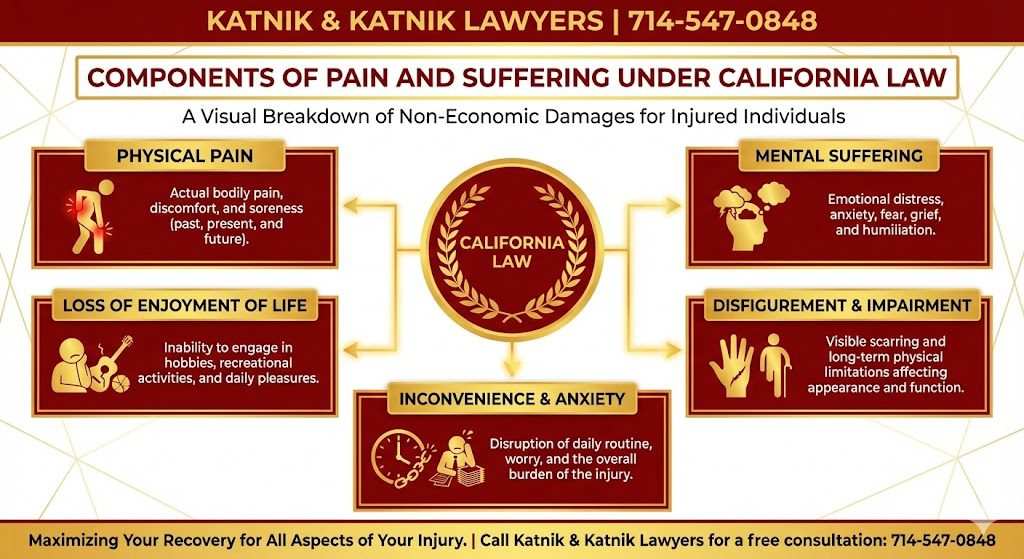
These are not just abstract concepts; they are legally defined. The Judicial Council of California Civil Jury Instructions (CACI) provides a framework for juries to understand and award these damages. Specifically, California Jury Instructions CACI 3905A outlines what can be included in a pain and suffering award. It is a comprehensive list designed to cover the full spectrum of human suffering that can result from someone else’s negligence.
According to CACI 3905A, there is no fixed standard for deciding the amount of these damages. A jury is instructed to use its judgment to decide a reasonable amount based on the evidence and common sense. The components of pain and suffering include:
- Physical Pain: This encompasses the actual, physical hurt you have endured since the injury and what you are reasonably certain to endure in the future. This can range from the acute pain of the initial trauma to chronic, debilitating pain that persists for years.
- Mental Suffering: This is a broad category that includes emotional and psychological harm. It covers conditions such as fright, shock, nervousness, grief, anxiety, worry, and mortification. Proving emotional distress in car accidents and other personal injury cases is a crucial part of demonstrating the full extent of your damages.
- Loss of Enjoyment of Life: This refers to the loss of your ability to participate in and derive pleasure from daily activities, hobbies, and social engagements you enjoyed before the injury. For instance, if you were an avid runner who can no longer run, or a musician who can no longer play your instrument, this represents a significant loss.
- Disfigurement: If your injury has caused scarring, amputation, or other permanent changes to your physical appearance, you can be compensated for the distress and humiliation associated with that disfigurement.
- Physical Impairment: This addresses the limitation on your body’s ability to function. It is distinct from the pain itself and focuses on what you can no longer do, such as lifting objects, walking without assistance, or performing certain job functions.
- Grief and Anxiety: While part of mental suffering, these are often highlighted. Grief can relate to the loss of a certain quality of life or abilities, while anxiety may manifest as PTSD, panic attacks, or a persistent state of worry following the traumatic event.
- Humiliation: This form of suffering is related to the feeling of being embarrassed or shamed by your injuries, such as having visible scars or needing help with personal care.
Understanding these components is the first step in building a case that accurately reflects your experience. It is not enough to simply state that you are in pain; you must present compelling evidence for each of these elements.
The Evidence Playbook: How to Prove Pain and Suffering in California
Since pain and suffering are subjective, building a strong case requires a strategic and thorough approach to gathering evidence. Insurance companies will often try to minimize these non-economic damages, arguing they are exaggerated or unfounded. The key to overcoming this is to present a detailed, consistent, and compelling narrative supported by credible documentation and testimony. Knowing how to prove pain and suffering in California is about turning your personal experience into objective proof.
Medical Records: The Foundation of Your Claim
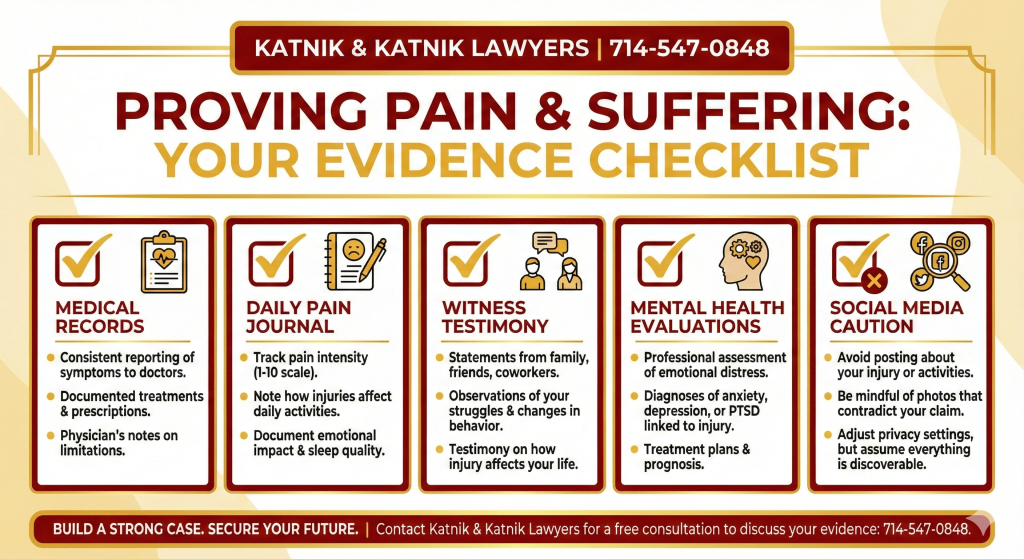
Your medical records are the cornerstone of your pain and suffering claim. They provide an objective, professional account of your physical injuries and the treatment you have received. To maximize their impact, ensure your records are comprehensive and clearly document not just the injury, but also its effect on your well-being. This includes physician’s notes on your reported pain levels, prescriptions for pain medication, and referrals to specialists. Consistent medical treatment demonstrates the seriousness of your injuries.
Daily Pain Journals: Your Personal Narrative
While medical records are vital, they don’t capture your day-to-day struggle. A daily pain journal is a powerful tool that fills this gap, providing a personal, chronological account of your experience. In your journal, you should document:
- Your daily pain levels on a scale of 1 to 10.
- The location and type of pain (e.g., sharp, dull, throbbing).
- How the pain impacts your daily activities, such as sleeping, working, or household chores.
- Any activities you were unable to do because of your pain.
- The emotional impact, including feelings of frustration, sadness, or anxiety.
A detailed journal transforms your abstract suffering into a concrete record that an insurance adjuster or jury can understand. It provides the texture and human element that raw medical data lacks.
In 2026, insurance adjusters frequently monitor social media to find photos of you smiling or traveling to “disprove” your pain and suffering; our team advises you on digital privacy throughout your claim.
How to Prove Pain and Suffering in California with ‘Before and After’ Witness Testimony
One of the most effective ways for how to prove pain and suffering in California is through the testimony of people who know you well. Friends, family members, coworkers, and supervisors can speak to the changes they have observed in you since the accident. Their “before and after” accounts can paint a vivid picture of your loss of enjoyment of life. They can testify about your once-active lifestyle, your positive demeanor, or your dedication to hobbies, and contrast that with your current state of withdrawal, irritability, or physical limitation. This third-party validation powerfully corroborates your own claims.
Mental Health Evaluations: Documenting the Invisible Wounds
The emotional toll of an accident can be just as devastating as the physical injuries. Proving emotional distress in car accidents often requires the expertise of a mental health professional. An evaluation from a psychologist or psychiatrist can result in a formal diagnosis, such as Post-Traumatic Stress Disorder (PTSD), anxiety disorder, or depression. This clinical diagnosis provides objective validation of your mental suffering and is incredibly difficult for an insurance company to dispute. Therapy records, like medical records, document your journey and struggles, creating a strong evidentiary basis for your claim.
The Math of Suffering: Multiplier Method vs. Per Diem Method
Once you have established evidence of your pain and suffering, the next challenge is assigning a monetary value to it. This is inherently difficult, as there is no simple formula for converting pain into dollars. However, attorneys and insurance companies commonly use two methods to arrive at a starting point for negotiations: the multiplier method vs per diem method.
The Multiplier Method is the most frequently used approach. It involves taking the total of your economic damages (medical bills and lost wages) and multiplying that figure by a number between 1.5 and 5. The multiplier is chosen based on the severity of your injuries, the egregiousness of the defendant’s conduct, the length of your recovery, and the long-term prognosis. A lower multiplier might be used for minor injuries with a quick recovery, while a higher multiplier is reserved for catastrophic injuries with permanent consequences.
The Per Diem Method (meaning “by the day”) assigns a daily rate to your suffering. This rate is often based on your daily earnings before the accident, using the logic that enduring pain is at least as difficult as going to work each day. The daily rate is then multiplied by the number of days you experienced pain, from the date of the accident until you reach maximum medical improvement.
Let’s compare these methods with a hypothetical case involving $50,000 in medical bills.
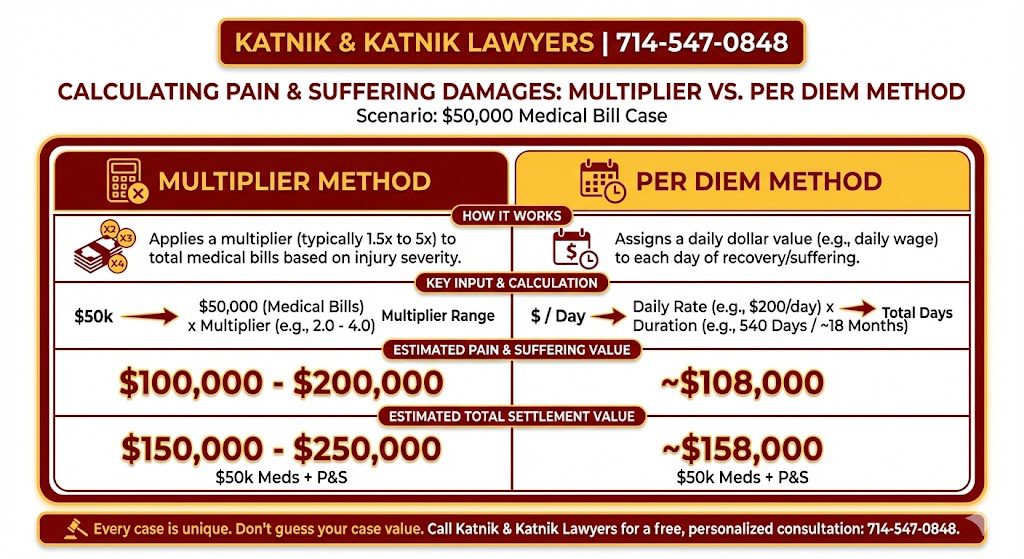
As you can see, the results can vary significantly. An experienced Santa Ana personal injury attorney will know which method is more appropriate for your specific case and how to argue for the highest reasonable valuation. These methods are not binding on a jury, but they provide a crucial framework for settlement negotiations.
2026 Legal Updates: Damage Caps and Survival Actions
The legal landscape in California is constantly evolving, and recent changes have a direct impact on pain and suffering claims. Staying informed about these updates is essential for any accident victim.
MICRA Damage Cap Updates for 2026
For decades, the Medical Injury Compensation Reform Act (MICRA) placed a strict $250,000 cap on non-economic damages in medical malpractice cases. This cap often prevented catastrophically injured patients from receiving fair compensation for their profound suffering.
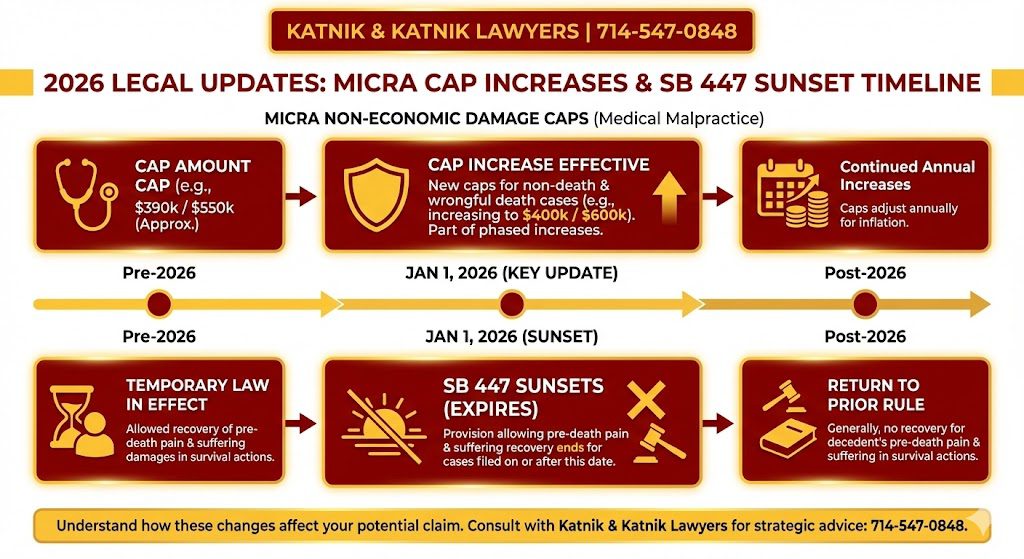
Fortunately, major reforms have been enacted. As of January 1, 2023, the cap was raised and continues to adjust annually. For claims filed in 2026, the cap on non-economic damages in non-fatal medical malpractice cases will be $470,000. For cases involving wrongful death, the cap will be $650,000. These figures will continue to increase each year until they reach $750,000 and $1,000,000, respectively, after which they will be adjusted for inflation. This is a significant victory for victims of medical negligence.
The Sunset of Senate Bill 447
Another critical development relates to survival actions. Previously in California, if a personal injury victim died before their case was resolved, their claim for pain and suffering damages died with them. This created a perverse incentive for defendants to delay litigation, hoping the plaintiff would not survive to see a verdict.
Senate Bill 447, which went into effect in 2022, temporarily changed this by allowing a deceased person’s estate to recover pain and suffering damages. However, this provision came with a sunset clause. Unless the legislature extends it, SB 447 is set to expire for all cases filed after January 1, 2026. This makes it more important than ever to act swiftly if you or a loved one has been injured.
How Katnik & Katnik Lawyers Use the “Unit Approach”
 At Katnik & Katnik, our firm’s philosophy is deeply rooted in the discipline and strategic mindset of football—a legacy passed down through three generations. For over 65 years, this approach has shaped our culture and driven our commitment to clients in every case we handle. We apply a “Unit Approach” to personal injury law, viewing each case as a field of play where preparation, teamwork, and a deep understanding of the opponent are paramount. This is especially true when we work on how to prove pain and suffering in California.
Just as a football team “scouts” its opponent to understand their tendencies and weaknesses, we meticulously analyze the insurance company’s tactics. We anticipate their attempts to downplay your pain, question your credibility, and minimize their payout. Our team—comprised of experienced attorneys, paralegals, and investigators—works as a cohesive unit to build a powerful narrative that proves your intangible losses.
We break down your suffering into individual “units” of evidence: the pain journal entry from a particularly bad day, the therapist’s note detailing a panic attack, the photo of you unable to attend your child’s school event. Each unit is a building block. By assembling these units with disciplined precision, we construct an undeniable story of your suffering. We don’t just present facts; we craft a compelling narrative that allows a claims adjuster, and if necessary a jury, to truly comprehend the depth of your loss. This team-based, strategic approach ensures that no aspect of your suffering is overlooked.
Frequently Asked Questions About Pain and Suffering Claims
How is pain and suffering calculated in California 2026?
There is no exact formula. Attorneys typically use the “multiplier method” (multiplying economic damages by a factor of 1.5-5) or the “per diem method” (assigning a daily rate for pain) to propose a value. Ultimately, a jury determines a reasonable amount based on the evidence presented, considering factors like the severity and permanence of the injury and the impact on your life.
Can I recover for emotional distress without a physical injury?
Yes, but it is challenging. California law allows for claims of negligent infliction of emotional distress (NIED). Generally, you must have been in the “zone of danger” of physical impact or have witnessed a close family member suffer a severe injury. Proving emotional distress in car accidents is more straightforward when it is tied to a physical injury, but recovery is possible in some standalone emotional distress cases.
What is the 99% rule in California?
This likely refers to California’s “pure comparative negligence” standard. Under this rule, you can recover damages even if you are 99% at fault for your accident. However, your total compensation will be reduced by your percentage of fault. For example, if you are awarded $100,000 but found to be 30% at fault, you would receive $70,000.
Do I need an expert witness to prove my pain?
While not always required, an expert witness can be incredibly valuable. Under California Evidence Code 801, an expert (like a doctor, psychologist, or vocational expert) can offer opinions based on their specialized knowledge. Their testimony can provide an objective, authoritative basis for your claims of pain, suffering, and future limitations, making your case much stronger.
Contact an Experienced Santa Ana Personal Injury Attorney
The aftermath of an accident is overwhelming, and the burden of proving your suffering should not be yours to bear alone. Understanding how to prove pain and suffering in California requires legal knowledge, strategic evidence gathering, and compassionate advocacy. The emotional and physical toll is real, and you deserve compensation that reflects your entire experience.
The attorneys at Katnik & Katnik Lawyers have dedicated over 65 years to fighting for the rights of injured individuals in Santa Ana and Orange County. We have the experience and dedication to build a compelling case on your behalf. Do not let an insurance company dictate the value of your suffering. Contact our team today for a free, no-obligation consultation. Call Katnik & Katnik Lawyers at 714-547-0848 and let us help you secure the justice you deserve.