The moment is unforgettable. You open the envelope from the insurance company, and the words leap off the page: “Claim Denied.” Your heart sinks. You are injured, out of work, and the system that was supposed to protect you has just shut the door. We understand the confusion, anger, and fear that follows. But as attorneys who have guided Santa Ana workers for over 65 years, we are here to tell you something vital: this is not the end of your case.
When your workers’ comp claim is denied, it feels like a final loss. But at Katnik & Katnik Lawyers, our “Football to Law” heritage taught us that a tough first half doesn’t decide the game. This denial is a challenge from the insurance carrier; it is not the final score. Now is the time for a halftime adjustment—a moment to regroup, build a new strategy, and come back stronger. This is where we begin the fight to secure the benefits you rightfully deserve.
Why a Workers’ Comp Claim Denied Letter is Just the First Quarter
Receiving a denial can be a deeply disheartening experience. Insurance companies word these letters in a way that feels final and absolute. They are designed to make you feel powerless and to convince you to give up. We have seen countless hardworking individuals in Orange County who, upon receiving this letter, simply stopped pursuing the benefits they desperately needed.
It is critical to understand this legal reality: an insurance adjuster’s “No” is not a judge’s “No.” The adjuster works for the insurance company, and their primary goal is to minimize payouts. A denial is simply their initial position. Consequently, it is an opinion that we can, and often do, challenge and overturn through the proper legal channels. Your case is far from over.
The Adjudication Truth: Why “Appealing” is a Misnomer
Many people believe the next step is to “appeal” the denial. While that term makes sense, it is not the correct legal process in California’s workers’ compensation system. Instead of an appeal, we initiate a process called Adjudication. This is a crucial distinction.
When we file an Application for Adjudication of Claim, we are not asking the insurance company to reconsider. We are formally opening a case with the state’s Division of Workers’ Compensation (DWC). This action disputes the insurance company’s decision and asks a workers’ compensation judge to make a ruling on the validity of your claim. It takes the power away from the adjuster and places it into the hands of a neutral third party.
Why Was Your Workers’ Comp Claim Denied?
Understanding the reason for the denial is the first step in building a strategy to fight it. While there are many reasons an adjuster might deny a claim, most fall into a few common categories.
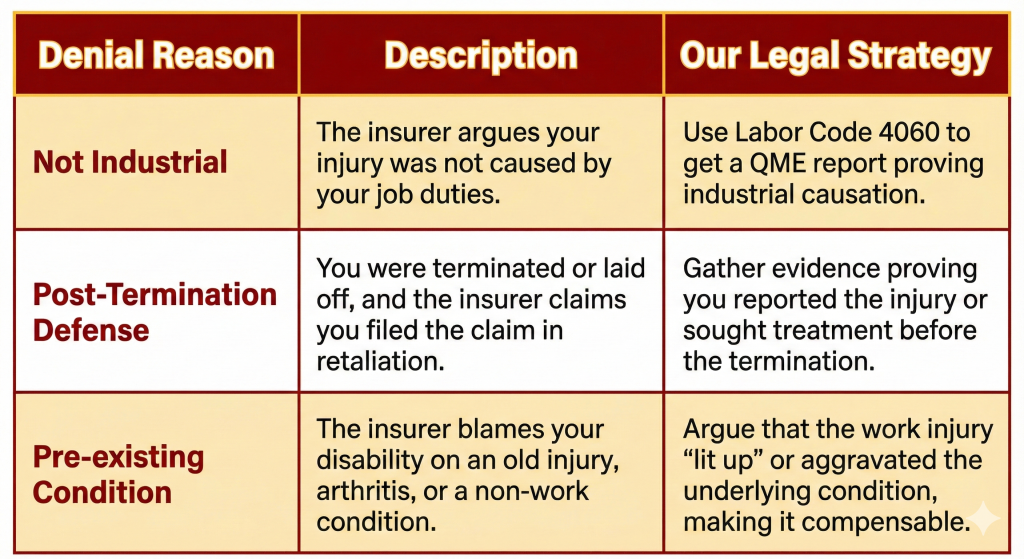
“Not Industrial” (Causation) Issues
This is the most common reason for a denial. The insurance company is stating that they do not believe your work activities are responsible for your injury. This is especially frequent with cumulative trauma injuries that develop over time. To counter this, we must produce strong medical evidence that proves the connection between your job and your condition.
The Post-Termination Defense
If you file a claim after being laid off or terminated, the insurance company will often deny it automatically. They will argue you are simply trying to get money after losing your job. However, the law provides exceptions. We can overcome this defense by showing that you reported the injury to your supervisor or had medical records related to the injury that existed before you were terminated.
Pre-existing Condition Traps
Insurers love to point to a pre-existing condition—like degenerative disc disease or prior surgery—and blame it for your current disability. In contrast, California law is clear: if your work duties “aggravated” or “lit up” a pre-existing, asymptomatic condition, the entire resulting disability is compensable. Our job is to prove that the work injury was the final straw that caused your condition to become disabling.
The 90-Day Rule, Labor Code 5402, and AB 1870 (Effective 2025)
California law gives the insurance company a limited window to investigate your claim. Under Labor Code 5402, they have exactly 90 days from the date you file your claim form to issue a denial. If the insurance company fails to respond with a denial within those 90 days, the law states that your injury is “presumed” to be compensable—a critical protection known as the Presumption of Compensability.
Strategic Note: Under Labor Code 5402, the insurance company has 90 days to investigate. If they haven’t sent a formal denial by day 91, the injury is presumed compensable. We often see adjusters rush out a denial on day 89 just to buy time. At Katnik & Katnik Lawyers, we audit these timelines meticulously to see if they missed their window.
This presumption is a powerful legal tool that can, in many cases, end the dispute swiftly in the worker’s favor. Once this presumption attaches, the burden of proof flips: the insurance company must now present solid, credible evidence to overturn your right to benefits—not the other way around. What does this mean for you? Even if the insurer tries to present new arguments or evidence after the deadline, the law strongly favors the injured worker. Judges are instructed to accept your claim as work-related unless there is overwhelming proof from the insurer to dispute it. This shift often makes it much harder for the carrier to deny ongoing benefits and helps level the playing field after months of frustration.
Additionally, during this 90-day period—even while they are investigating—the insurance company must authorize up to $10,000 in reasonable and necessary medical treatment. If your claim is denied before the end of the 90 days, this obligation stops at that point. That’s why it’s vital to act quickly and keep detailed records from the moment your injury occurs.
Importantly, as of January 1, 2025, under AB 1870, all California employers are required to notify injured workers of their right to consult with an attorney when a claim is filed. This new law reinforces your protections and ensures you know your rights from the very start.
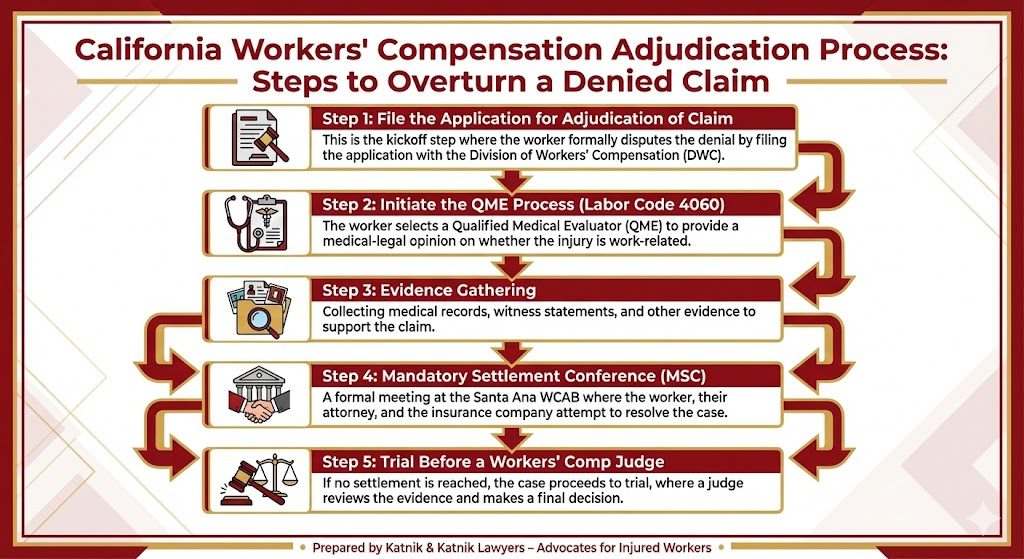
The Katnik & Katnik Playbook: 5 Steps to Overturn a Denied Claim
When a workers’ comp claim is denied, we have a proven playbook to fight back. This is our methodical approach to taking control of the case and moving toward a successful resolution.
- File the Application for Adjudication of Claim (The “Kickoff”): This is the first and most critical step. We immediately file the necessary paperwork with the DWC to establish a case number and formally notify the court and the insurance company that we are challenging the denial. This officially starts the legal game.
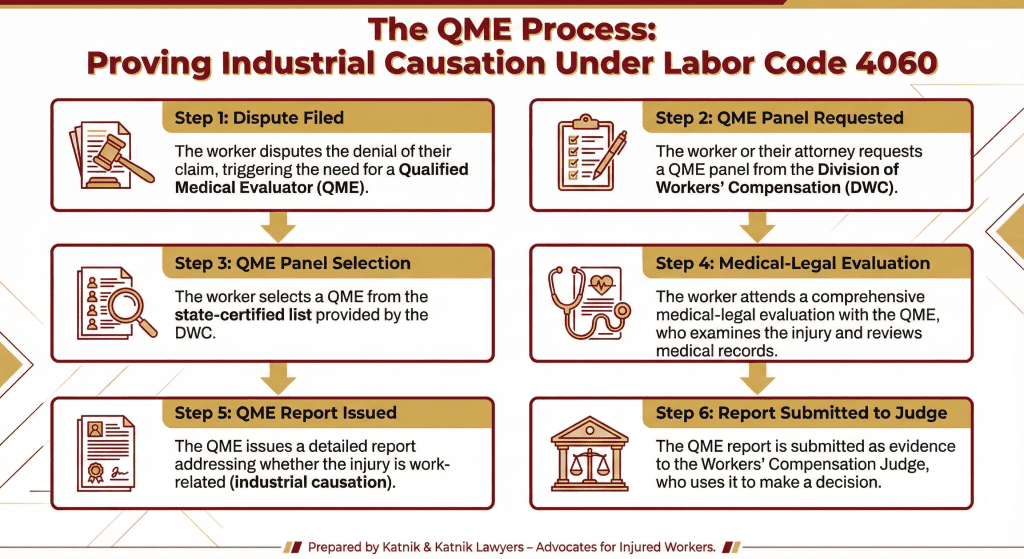
- The QME Process under Labor Code 4060: Since the core dispute is medical—specifically, whether the injury is work-related—we must secure a medical-legal opinion. We use Labor Code 4060 to initiate the Qualified Medical Evaluator (QME) process. This involves selecting a neutral doctor from a state-certified panel who will examine you, review all your records, and issue a report on whether your injury was caused by work activities.
Strategic Note: The QME under Labor Code 4060 is not just another medical appointment. Unlike a regular treating physician or an “Independent Medical Examination” (IME)—which are rarely used in California now—the 4060 QME is specifically designated to resolve the key legal question of industrial causation. This doctor’s only job is to determine, based on a thorough review and a formal interview, whether your injury is covered under California workers’ compensation law. The 4060 QME isn’t hand-picked by the insurance company or your employer—this neutral process is tightly regulated to ensure fairness. A well-prepared QME examination and an evidence-based presentation can be the single most powerful tool in overturning a denied claim, as the judge will heavily weigh this report in deciding your case.
Pro Tip: In a denied case, you are not just “seeing a doctor.” You are undergoing a comprehensive medical-legal evaluation. Unlike the employer’s clinic doctor, the QME’s report carries massive weight with the Judge. We help you prepare for this exam so you know exactly how to describe your job duties and injury.
3. Evidence Gathering (The “Film Session”): While awaiting the QME process, we go to work. We gather all prior medical records, take statements from you and any witnesses, collect personnel files, and prepare a comprehensive summary of your case. We ensure the QME has all the evidence needed to understand how your work caused your injury.
4. The Mandatory Settlement Conference (MSC) at Santa Ana WCAB: Once the QME report is ready, the parties attend an MSC at the local Workers’ Compensation Appeals Board. This is a formal meeting where we present our evidence to the insurance company’s attorney and a judge to try and resolve the case. A favorable QME report often forces the insurer to accept the claim at this stage.
5. Trial Before a Workers’ Comp Judge: If the insurance company still refuses to accept the claim, we proceed to trial. We present our evidence, cross-examine the insurance company’s witnesses, and make our arguments directly to the judge. At Katnik & Katnik, we prepare every case as if it is going to trial, ensuring we are always ready for the final fight.
Why IMEs and UR Are Not Part of This Fight
You may find information online that suggests other procedures, but it is often outdated or incorrect. As specialists, we want to clarify two common points of confusion to build your trust in our strategy:
- Utilization Review (UR): UR is a process insurance companies use to review medical treatment requests for accepted claims. It has absolutely no role in deciding whether to deny a claim from the outset. If your entire claim is denied, UR is not a factor.
- Independent Medical Examinations (IMEs): The term “IME” is a relic of an old system. Today, these exams are very rare and are almost never used to decide a denied case. The proper and legally mandated process is to use a QME under Labor Code § 4060. Any attorney suggesting an IME for a denied case may not be current on California workers’ comp law.
Why Santa Ana Workers Need the Katnik & Katnik Defense
Pro Tip for Santa Ana Workers:
Attending a hearing at the Santa Ana Workers’ Compensation Appeals Board? Preparation is your best ally. Arrive early to find parking and allow time for the security process. Bring all essential documents—like your denial letter, medical records, and correspondence—neatly organized and easily accessible. Clear, honest answers are key.
Board Location: 2 MacArthur Place, Suite 600, Santa Ana, CA 92707
For over 65 years, our firm has been a part of the Santa Ana community. We are not a faceless national firm; we are local attorneys who have dedicated our careers to helping the hardworking people of Orange County. We understand the physical and financial pressures you face, and our professional commitment is to provide the compassionate and reliable advocacy you need during this difficult time.
Our clients are not just case files. We believe the practice of law comes down to caring for the people we represent. As your Santa Ana workers’ comp lawyer, we bring a legacy of trust and a history of successfully taking on insurance giants. We will give your case the time and attention it deserves.
Frequently Asked Questions
What is a QME?
A QME, or Qualified Medical Evaluator, is a state-certified physician who is chosen to act as a neutral medical expert in a workers’ compensation dispute. Their job is to examine the injured worker and issue a report that resolves a medical-legal issue, such as the cause of an injury.
Can I see my own doctor if my claim is denied?
If your claim is denied, the workers’ compensation insurance will not pay for any medical care. You can seek treatment through your private health insurance, but you should inform your doctor that it is for a potential work injury. It is essential to speak with an attorney before doing so to protect your rights.
How long do I have to file a dispute?
You must file an Application for Adjudication of Claim within one year from the date of denial. The clock is ticking, and missing this deadline can permanently bar you from receiving any benefits.
Does it cost money to hire a lawyer for a denied claim?
No. At Katnik & Katnik Lawyers, we handle all workers’ compensation cases on a contingency fee basis. This means you pay no attorney’s fees upfront. We only get paid a small percentage of the benefits we recover for you at the end of the case. If we don’t win, you owe us nothing.
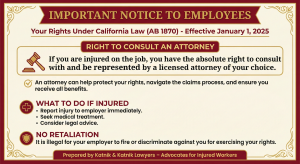
What is AB 1870, and how does it help me?
Effective January 1, 2025, AB 1870 requires California employers to inform workers that they have the right to consult an attorney regarding their workers’ comp rights. This ensures you know that help is available the moment a dispute arises.
A Denial is a Challenge, Not a Defeat
When your workers’ comp claim is denied, you have a choice. You can accept the insurance company’s decision, or you can fight back. The law provides a clear path to challenge a denial, but the deadlines are strict and the process is complex. The clock is ticking on your right to act. Remember, the insurance company’s initial denial is a strategic move, not a final judgment.
At Katnik & Katnik, we are prepared to take on that challenge with you and for you. We have the experience, the dedication, and the aggressive advocacy needed to navigate this fight.
A denial is a challenge, not a defeat. Call Katnik & Katnik Lawyers today for a free, confidential strategy session. Let our family help yours.